
Fatehpur Sikri Day Trip from Agra: Complete Travel Guide (2026)
Fatehpur Sikri is a 16th-century Mughal city and UNESCO World Heritage Site located approximately 37 km southwest of Agra. Built by Emperor Akbar between 1571 and 1585, it served as the capital of the Mughal Empire before being abandoned due to water scarcity. Today, the remarkably well-preserved red sandstone complex is one of the most significant historical sites in northern India.
A Fatehpur Sikri day trip from Agra is one of the most practical half-day excursions available to travelers visiting Agra. Many travelers who book Taj Mahal tour packages add this historic site to their itinerary to explore the region’s Mughal heritage. The journey takes under an hour by road, the site can be explored in 2–3 hours, and the architectural quality rivals anything in Agra itself. This guide covers everything you need to plan the trip in 2026 — transport, timing, costs, attractions, and a workable itinerary.
Why Visit Fatehpur Sikri from Agra?
Fatehpur Sikri is worth visiting because it is one of the best-preserved examples of Mughal civic planning and architecture anywhere in India, and it is close enough to Agra to visit without disrupting your main itinerary.
Historical importance. Emperor Akbar built this city after the Sufi saint Sheikh Salim Chishti correctly predicted the birth of his heir, Prince Salim (later Emperor Jahangir). The city became the political and cultural center of the Mughal Empire from 1571 to 1585 — a period that shaped Indian history.
Architecture. Fatehpur Sikri features a distinctive blend of Persian, Indian, and Islamic architectural styles, all constructed primarily in locally quarried red sandstone. The Buland Darwaza, Panch Mahal, and the Tomb of Sheikh Salim Chishti are architectural achievements that stand apart from what you see at the Taj Mahal or Agra Fort.
UNESCO recognition. Inscribed as a UNESCO World Heritage Site in 1986, Fatehpur Sikri is recognized for its outstanding universal value as a complete Mughal city that remains largely intact.
Proximity. At roughly 37 km from central Agra, Fatehpur Sikri can be comfortably visited as a morning or afternoon excursion, making it easy to combine with Agra’s other monuments.
How Far Is Fatehpur Sikri from Agra?
Fatehpur Sikri is approximately 36–40 km from Agra, depending on your starting point in the city. The journey takes around 45 minutes to 1.5 hours by road, with most travelers reaching the site in about an hour under normal traffic conditions.
The drive follows the Agra–Jaipur highway (NH-21). Road conditions are generally good, though traffic congestion near Agra city limits can add time during peak hours. Starting early in the morning typically ensures a smoother drive.
Planning Your Agra to Fatehpur Sikri Trip?
Looking for the easiest way to visit Fatehpur Sikri from Agra? Choose a convenient private car or sightseeing option that fits your schedule, comfort and Agra sightseeing plans.
How to Reach Fatehpur Sikri from Agra
By Private Car or Taxi
A private car or pre-booked taxi is the most convenient option for most travelers. It offers door-to-door service, air conditioning, flexible departure times, and the ability to stop along the way. Round-trip taxi fares for a sedan typically range from ₹1,000 to ₹2,000, depending on the vehicle type and operator. SUVs and premium vehicles cost more.
Private cars are especially practical for families, groups, senior travelers, and international visitors looking for convenient same-day tours from Agra.
Tip: Arrange a round trip with waiting time rather than a one-way drop. Finding return transport from Fatehpur Sikri can be less convenient than arranging it in advance.
By Bus
UPSRTC (Uttar Pradesh State Road Transport Corporation) operates regular bus services from Agra’s Idgah Bus Stand to Fatehpur Sikri. The journey takes approximately one hour, and fares start from around ₹60–70 for a non-AC bus. Buses run frequently throughout the day.
Buses are the most budget-friendly option and work well for solo travelers comfortable with basic public transport. However, they are less convenient for families with children or travelers carrying luggage, and the last-mile connection from the bus stop to the monument entrance requires an auto-rickshaw or a short walk.
By Train and Local Transport
Fatehpur Sikri has its own railway station, connected to Agra Fort station. The train journey takes approximately 50–60 minutes. However, train frequency on this route is limited, and the railway station is about 1 km from the monument complex, requiring an auto-rickshaw for the final stretch.
Trains are a viable option for budget travelers with flexible schedules, but the limited timetable makes planning a day trip less convenient than road transport.
Recommendation: For most travelers, a private car or taxi offers the best balance of comfort, flexibility, and value. Budget travelers comfortable with public transport can take the UPSRTC bus.
Best Time to Visit Fatehpur Sikri
The best time to visit Fatehpur Sikri is October through March, when temperatures are moderate and comfortable for outdoor sightseeing.
- Winter (November–February): Daytime temperatures range from 10°C to 25°C — ideal for walking through the open courtyards and monuments. December and January mornings can be foggy and cold; carry a light jacket.
- Summer (April–June): Temperatures routinely exceed 40°C. The site is almost entirely open-air, with limited shade. Visiting in summer requires very early morning arrival and careful heat management. It is not recommended for elderly travelers or young children during peak heat.
- Monsoon (July–September): Rain cools temperatures but can make stone walkways slippery. The site is open during monsoon, and crowds are typically lighter.
Best time of day: Arrive early in the morning — ideally by 8:00–9:00 AM. Morning light is best for photography, temperatures are cooler, and crowds are smaller. By midday, especially from March onward, the exposed sandstone courtyards become uncomfortably hot.
Top Places to Visit in Fatehpur Sikri
Fatehpur Sikri’s monuments are spread across two main areas: the Royal Palace Complex (ticketed) and the Jama Masjid complex (free entry). Here are the key attractions.
Buland Darwaza
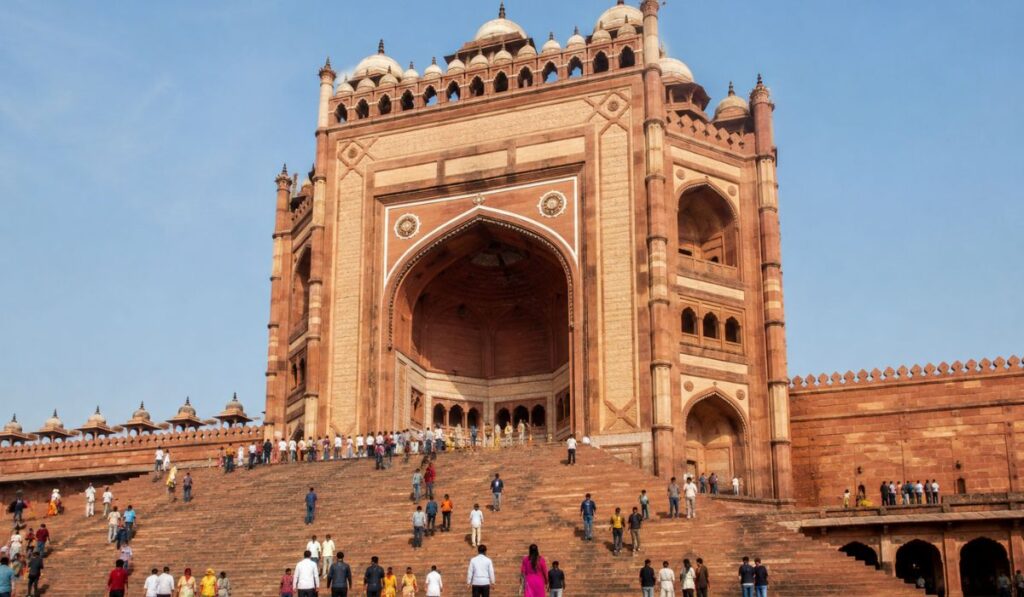
The Buland Darwaza (“Gate of Magnificence”) is one of the tallest gateways in the world, standing approximately 54 meters high. Built around 1601 to commemorate Akbar’s victory over Gujarat, it is constructed from red and buff sandstone with white and black marble inlay work. A flight of 42 steps leads up to the gateway, which features Quranic inscriptions and the famous line attributed to Jesus: “The world is a bridge; pass over it, but build no houses upon it.” The gateway serves as the main entrance to the Jama Masjid complex.
Jama Masjid
One of the largest mosques in India, the Jama Masjid at Fatehpur Sikri was among the first structures Akbar commissioned. The vast courtyard can accommodate thousands of worshippers. The mosque remains an active place of worship, and entry is free for all visitors. Modest clothing is required.
Tomb of Sheikh Salim Chishti
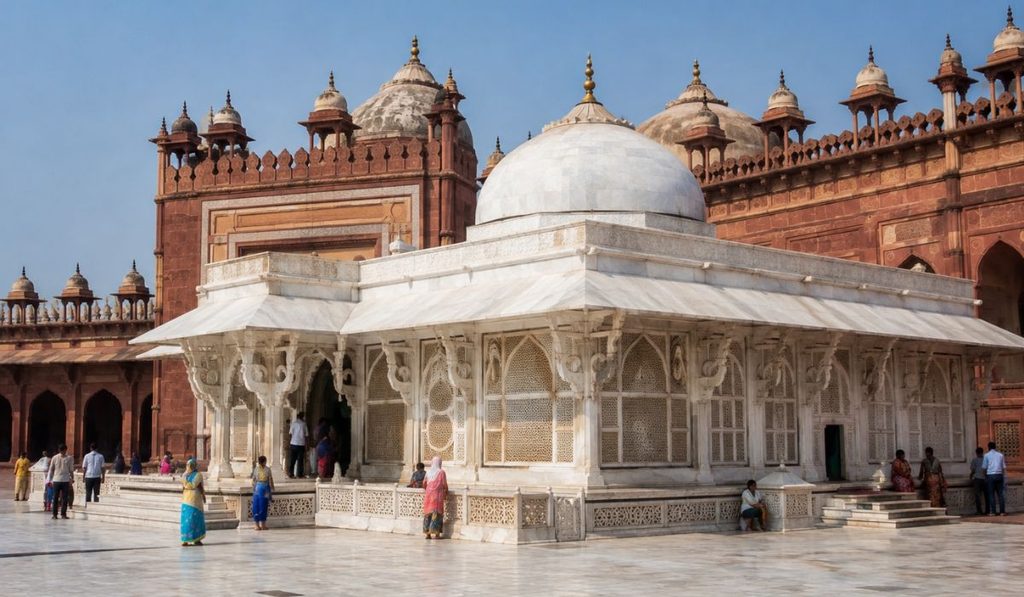
Located within the Jama Masjid courtyard, this white marble tomb honors the Sufi saint who predicted the birth of Akbar’s son. The tomb features exquisitely carved marble jali (lattice screens) that are considered among the finest in Mughal architecture. Visitors of all faiths come here to tie threads on the screens and make wishes — a tradition that continues today.
Diwan-i-Khas (Hall of Private Audience)
This structure housed Akbar’s private meetings with senior advisors, scholars, and religious leaders. Its most notable feature is a central pillar with an elaborate capital, connected to the corners of the room by elevated walkways. This unusual layout is thought to reflect Akbar’s interest in engaging with representatives of different faiths — a physical expression of his policy of religious dialogue.
Diwan-i-Aam (Hall of Public Audience)
The Diwan-i-Aam was where Akbar held court for the general public and administered justice. The large open courtyard with a raised platform follows the classic Mughal court layout. Look for the carved stone screen behind which court proceedings were observed.
Panch Mahal
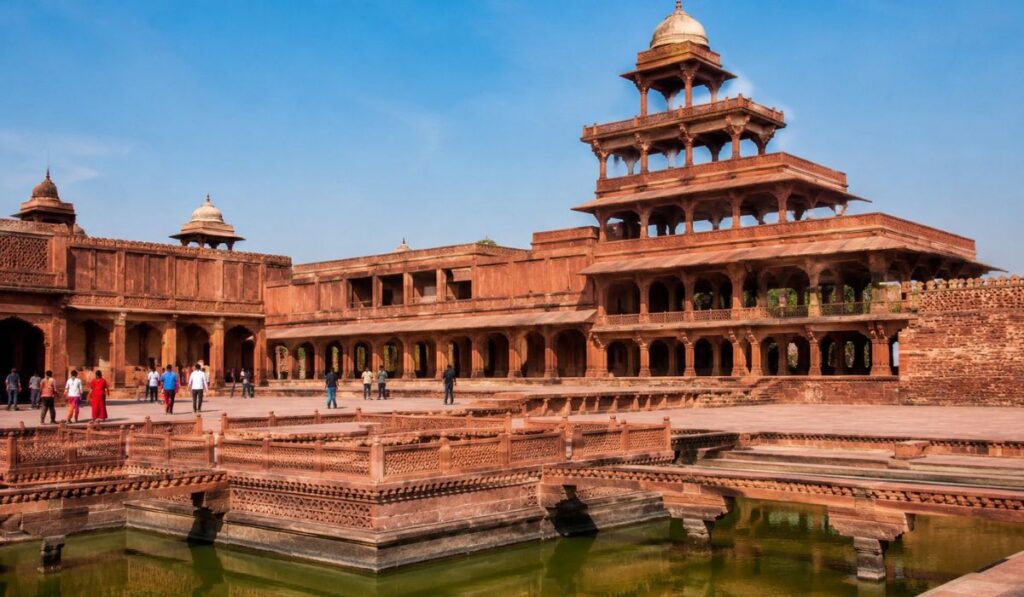
The Panch Mahal is a five-story palatial structure with open terraces supported by 176 columns, each uniquely carved. The tiers diminish in size from ground to top, creating a pyramidal silhouette. It was likely used as a leisure pavilion and offers views across the complex. The structure has no walls — only columns — giving it an appearance unlike any other Mughal building.
Jodha Bai’s Palace (Mariam-uz-Zamani Palace)
The largest palace in the complex, this was the residence of Akbar’s principal queen. It blends Hindu and Islamic architectural elements — a reflection of the Mughal court’s cultural integration. Look for the Hindu-style brackets, carved balconies, and blue-glazed tile work that distinguish it from the surrounding structures.
Anup Talao
Anup Talao is an ornamental pool with a central platform connected by four walkways, creating a symmetrical cross-shaped design. Court musicians, including the legendary Tansen, are said to have performed on the central platform. The pool is now dry but remains architecturally significant and makes for a good photograph.
Fatehpur Sikri History and Architecture
Emperor Akbar founded Fatehpur Sikri in 1571 on the site of the village of Sikri, where the Sufi mystic Sheikh Salim Chishti lived. After the saint’s prediction of a male heir came true, Akbar shifted his capital here from Agra and embarked on an ambitious construction program that created an entire city within roughly two years.
The name “Fatehpur Sikri” — meaning “City of Victory” — was given after Akbar’s military conquest of Gujarat in 1573. For 14 years, the city served as the Mughal Empire’s political, administrative, and cultural center. It was here that Akbar held his famous religious debates, developed the Din-i-Ilahi syncretic philosophy, and patronized arts, music, and literature.
The city was largely abandoned around 1585, primarily because of insufficient water supply to sustain a growing population. The capital shifted to Lahore, and Fatehpur Sikri was never reoccupied as a seat of power.
Architecturally, the city is notable for its synthesis of styles. While the primary material is red sandstone from the Vindhyan range, the buildings incorporate Persian arches, Hindu brackets and columns, Jain decorative motifs, and Islamic geometric patterns. This fusion reflects Akbar’s deliberate policy of cultural integration, making Fatehpur Sikri architecturally distinct from both earlier and later Mughal construction.
The Archaeological Survey of India (ASI) maintains the site, which remains one of the most complete surviving examples of a Mughal-era city.
How Long Do You Need at Fatehpur Sikri?
Most visitors need 2 to 3 hours to see the main monuments at Fatehpur Sikri comfortably.
- Quick visit (1.5–2 hours): Covers the major highlights — Buland Darwaza, Jama Masjid, Sheikh Salim Chishti’s Tomb, Panch Mahal, and one or two palace structures. Suitable if you are short on time.
- Standard visit (2.5–3 hours): Allows you to explore both the mosque complex and the Royal Palace Complex at a comfortable pace, with time for photography.
- Relaxed visit (3–4 hours): Includes all major and minor structures, unhurried photography, and time to absorb the atmosphere. Best for history and architecture enthusiasts.
The site involves considerable walking across open courtyards and uneven stone surfaces. Factor in rest breaks, especially in warm weather.
Best Fatehpur Sikri Day Trip Itinerary from Agra
Here is a practical half-day itinerary that works for most travelers:
7:00–7:30 AM — Depart your Agra hotel by private car or taxi.
8:00–8:30 AM — Arrive at Fatehpur Sikri. Purchase tickets at the entrance or use the ASI online booking portal.
8:30–10:00 AM — Explore the Royal Palace Complex: Diwan-i-Khas, Diwan-i-Aam, Panch Mahal, Jodha Bai’s Palace, Anup Talao, and other palace structures.
10:00–11:00 AM — Visit the Jama Masjid complex (free entry): Buland Darwaza, Jama Masjid, and the Tomb of Sheikh Salim Chishti.
11:00–11:30 AM — Head back to the parking area. Depart for Agra.
12:00–12:30 PM — Arrive back in Agra.
Afternoon — Rest, lunch, and then visit the Taj Mahal (if visiting in the afternoon) or Agra Fort.
Can you combine Fatehpur Sikri with the Taj Mahal in one day? Yes. By starting early and returning to Agra by midday, you can comfortably visit the Taj Mahal in the afternoon or combine your visit with broader Agra city tours in the late afternoon. Many travelers do the Taj Mahal at sunrise, visit Fatehpur Sikri mid-morning, and end the day at Agra Fort. This is a full day, but manageable with a private vehicle.
Planning Your Agra to Fatehpur Sikri Trip?
Looking for the easiest way to visit Fatehpur Sikri from Agra? Choose a convenient private car or sightseeing option that fits your schedule, comfort and Agra sightseeing plans.
Fatehpur Sikri Timings, Tickets, and Travel Costs
Opening hours: Fatehpur Sikri’s Royal Palace Complex is open sunrise to sunset, all seven days of the week. Ticket counters generally close 30 minutes before sunset.
Entry tickets (Royal Palace Complex):
| Category | Online (ASI Portal) | Cash at Counter |
|---|---|---|
| Indian citizens / SAARC / BIMSTEC nationals | ₹35 | ₹50 |
| Other foreign visitors | ₹550 | ₹600 |
| Children under 15 (all nationalities) | Free | Free |
The Jama Masjid and Tomb of Sheikh Salim Chishti are free to enter for everyone.
Note: Foreign visitors with a same-day Taj Mahal ADA toll tax receipt may not need to repay the ADA component at Fatehpur Sikri. Ticket prices are managed by the Archaeological Survey of India (ASI) and may be revised. Verify current rates on the ASI website before your visit.
Parking and access: Private vehicles must park at the Gulistan Tourist Complex, approximately 1.5 km from the monuments. Battery-operated eco-buses and golf carts shuttle visitors to the entrance for around ₹10 per person. Alternatively, you can walk uphill in 15–20 minutes.
Estimated day-trip costs from Agra (per person, approximate):
| Expense | Budget Estimate | Mid-Range Estimate |
|---|---|---|
| Round-trip transport (shared/bus) | ₹130–150 | — |
| Round-trip transport (private car) | — | ₹1,000–2,000 (total) |
| Entry ticket (Indian) | ₹50 | ₹50 |
| Entry ticket (foreign) | ₹610 | ₹610 |
| Local guide (optional) | ₹300–500 | ₹500–800 |
| Water and snacks | ₹50–100 | ₹100–200 |
Private Car vs Public Transport for Fatehpur Sikri
| Factor | Private Car / Taxi | Public Transport (Bus) |
|---|---|---|
| Comfort | Air-conditioned, door-to-door | Basic seating, crowded at peak times |
| Flexibility | Depart anytime, return when ready | Fixed schedules, limited frequency |
| Travel time | 45 min – 1 hr (direct) | ~1 hr + last-mile auto-rickshaw |
| Cost (round trip) | ₹1,000–2,000 total | ₹130–150 per person |
| Best for | Families, groups, international visitors, seniors | Solo budget travelers, backpackers |
Practical Travel Tips for Fatehpur Sikri
- Footwear: Wear comfortable walking shoes with good grip. You will walk on uneven stone surfaces, and shoes must be removed at the Tomb of Sheikh Salim Chishti and inside the mosque.
- Water: Carry at least 1–2 liters. There are limited water vendors inside the complex.
- Sun protection: Bring sunscreen, sunglasses, and a hat or scarf. Most of the site is exposed, with very little shade.
- Clothing: Modest clothing is required to enter the Jama Masjid and tomb. Shoulders and knees should be covered, and head coverings are required in the mosque and dargah courtyard. Carry a scarf or cap.
- Photography: Photography is allowed at most structures. Morning light (before 10 AM) produces the best results on the red sandstone. Drones are strictly prohibited without prior authorization from ASI and civil aviation authorities. Tripods are not permitted for regular visitors.
- Guides: Licensed ASI-approved guides are available at the entrance. Agree on the fee and scope of the tour before starting. A guide adds significant historical context, especially at structures like Diwan-i-Khas and Anup Talao, where the architectural details have complex stories behind them.
- Unofficial vendors: You will encounter persistent vendors and unofficial guides near the entrance and inside the complex. A polite refusal is usually sufficient.
- Families and seniors: The site involves stairs (particularly at Buland Darwaza) and extended walking. Travelers with mobility limitations should plan accordingly; some areas may not be accessible.
- Return transport: If you arrived by private car, confirm the driver’s waiting location and phone number. If you arrived by bus, check return bus timing in advance to avoid a long wait.
- Further reading: For additional regional itineraries, accommodation guides, and destination insights across northern India, explore our India travel blog.
Is Fatehpur Sikri Worth Visiting from Agra?
Fatehpur Sikri is worth visiting for most travelers spending more than one day in Agra. It offers an architectural and historical experience distinct from the Taj Mahal and Agra Fort — a complete Mughal city rather than a single monument.
Best suited for:
- First-time Agra visitors who want to see more of India’s Mughal heritage beyond the Taj Mahal.
- History and architecture enthusiasts who will appreciate the unique fusion of building styles and the city’s political significance.
- Photographers who want to capture red sandstone architecture in a less crowded setting than Agra’s main monuments.
- International travelers looking for an immersive half-day excursion that doesn’t require complex logistics.
Limitations to consider:
- The site is almost entirely open-air, making summer visits physically demanding.
- There are limited food and refreshment options at the site.
- Travelers with mobility issues may find the stairs and uneven terrain challenging.
- If you have only a few hours in Agra, the Taj Mahal and Agra Fort should take priority.
On balance, Fatehpur Sikri adds substantial value to an Agra itinerary for anyone with half a day to spare.
Frequently Asked Questions About Fatehpur Sikri from Agra
How far is Fatehpur Sikri from Agra?
Fatehpur Sikri is approximately 36–40 km from Agra, about 45 minutes to 1.5 hours by road depending on traffic.
How long does it take to reach Fatehpur Sikri from Agra?
By private car or taxi, the journey takes approximately 45 minutes to 1 hour. UPSRTC buses take around 1 hour from Idgah Bus Stand.
How many hours are enough for Fatehpur Sikri?
Most visitors need 2–3 hours for a comfortable visit covering all major monuments. A quick visit focusing on highlights takes about 1.5–2 hours.
Can I visit Fatehpur Sikri and the Taj Mahal in one day?
Yes. A common approach is to visit the Taj Mahal early morning, drive to Fatehpur Sikri mid-morning, and return to Agra by early afternoon. With a private vehicle, this is manageable.
What is the best time to visit Fatehpur Sikri?
October through March offers the most comfortable weather. Within the day, arrive early in the morning (by 8–9 AM) to avoid heat and crowds.
Is Fatehpur Sikri worth visiting?
Yes, for most travelers. It is a UNESCO World Heritage Site with architecture distinct from the Taj Mahal, and the half-day time investment is modest. It is less worthwhile if you have very limited time and haven’t yet seen the Taj Mahal and Agra Fort.
How can I travel from Agra to Fatehpur Sikri?
The most convenient option is a private car or taxi (₹1,000–2,000 round trip). UPSRTC buses from Idgah Bus Stand are the budget option (approximately ₹60–70 one way). Trains run on a limited schedule.
Do I need a guide at Fatehpur Sikri?
A guide is not required but recommended. Fatehpur Sikri’s history and architectural details are complex, and a knowledgeable guide significantly enriches the experience. Licensed ASI guides are available at the entrance; agree on fees before starting.