
Taj Mahal Sunrise vs Sunset — Which Time is Actually Better?
Let’s be real. The moment you start planning a Taj Mahal trip, someone says, “Yaar, go at sunrise.” Then another friend insists, “No bhai, sunset hai toh sunset — the light is magical.” And suddenly you’re in a WhatsApp argument at 11 PM with no clear winner.
So here it is — a proper, no-fluff breakdown of Taj Mahal Sunrise vs Sunset. Not based on what looks pretty on Instagram. Based on what actually makes a difference when you’re standing in front of one of the most breathtaking structures on earth.
Spoiler: both are stunning. But one is clearly better for most people — and you’ll know exactly which one by the end of this article.
Why Timing Changes Everything at the Taj
The Taj Mahal isn’t just architecture. It’s an experience shaped by light, crowd density, temperature, and your own energy level. The same monument looks completely different at 6 AM versus 6 PM. And the Taj Mahal visiting time you choose directly affects all of these factors.
Early morning brings cool air, soft diffused light, and far fewer people. Evening brings gold-dipped drama and a buzzing atmosphere. Neither is wrong — they just serve different kinds of travellers.
Here’s what changes with timing:
- Light quality — Diffused blue-pink tones at dawn vs warm amber-orange at dusk. Both are camera-worthy, but the mood is completely different.
- Crowd density — Sunrise sees the thinnest crowds of the day. Post-noon footfall can triple. Taj Mahal crowd timing genuinely affects your experience.
- Temperature — Agra is no joke in summer. Sunrise means cooler, bearable air. Late afternoon visits in May or June can feel punishing.
- Photography conditions — Softer, longer shadows at sunrise. Richer golden saturation at sunset. Both have their merits for Taj Mahal photography.
Taj Mahal at Sunrise — The Real Experience
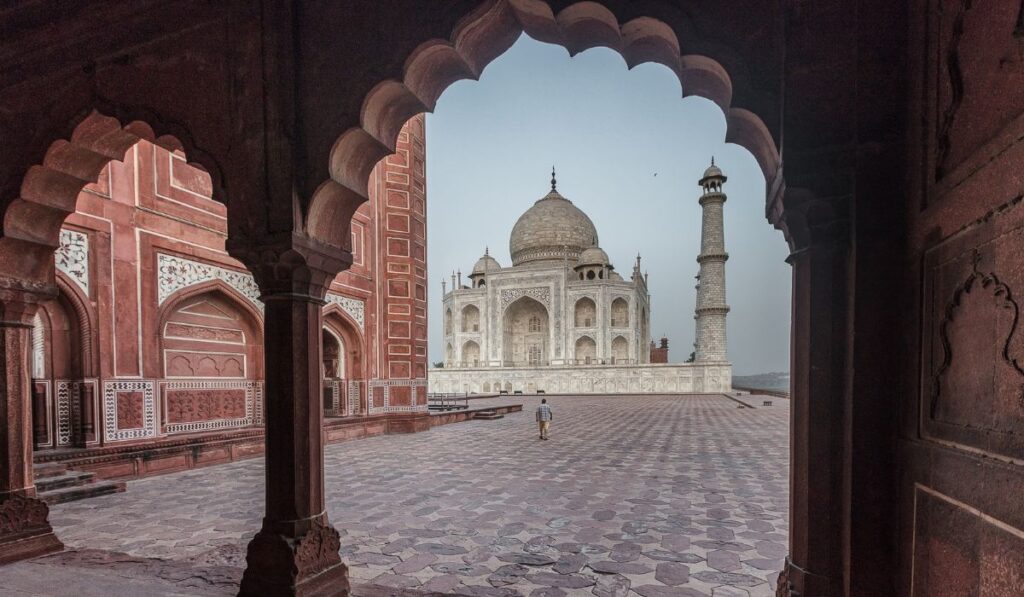
The alarm goes off at 4:30 AM. You groan. But then you step through the main gate just as the sky shifts from deep indigo to blush pink — and the Taj is right there, glowing like it was carved from moonlight. That feeling? Absolutely worth every lost minute of sleep.
The Taj Mahal Sunrise Tour is genuinely something else. In the first hour after opening, you can walk across the central garden with maybe 50 other people around you. The white marble looks almost translucent. There’s no noise, no group tour guides with megaphones, no crowds fighting for the same shot. Just you, and this ridiculous wonder of the world.
What the early morning Taj Mahal visit actually feels like
The light at sunrise is cool and directional — perfect for long shadows and silhouettes. The Taj’s white marble changes colour every 10 minutes, going from pale lavender to warm cream to bright white as the sun climbs. Photographers love this hour. You won’t be fighting for the famous bench shot with 200 people behind you, and in front of you, and beside you.
Sunrise — Pros:
- Thinnest crowds of the entire day
- Cooler air — essential if visiting in summer
- Soft, dramatic photography light
- Peaceful, almost meditative atmosphere
- More personal, intimate experience
Sunrise — Cons:
- Very early wake-up required (4:30–5 AM)
- Winter morning fog can reduce visibility
- Entry timing is strict — no late arrivals
Taj Mahal at Sunset — Golden Hour Drama
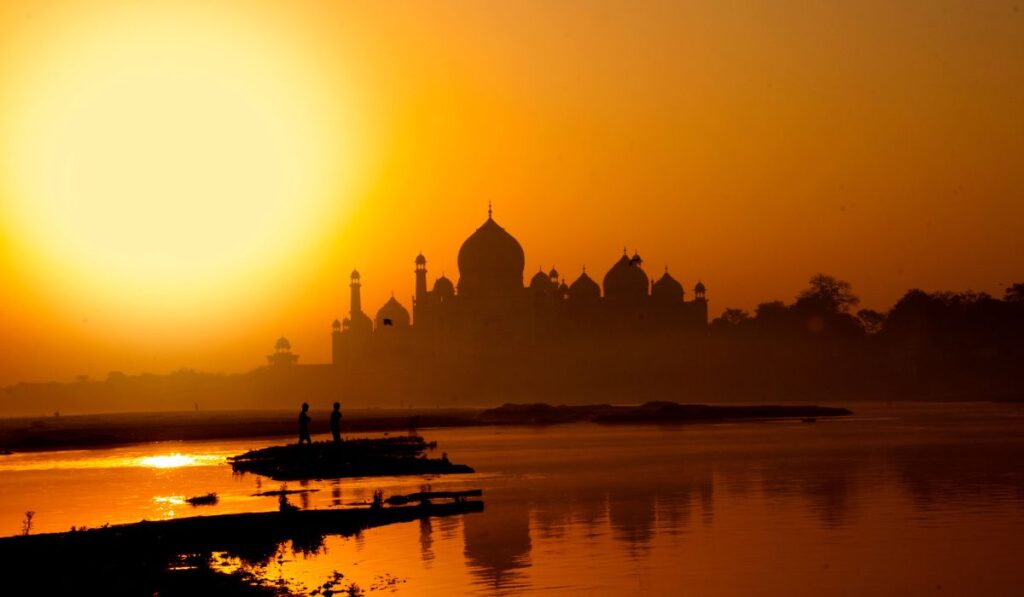
If sunrise is meditative, the Taj Mahal sunset view is pure cinema. The Taj turns a deep, honeyed gold as the sun dips below the horizon. The marble absorbs the warm light and throws it back at you like the building is lit from within. It’s hard to describe without sounding like a cliché — but the light genuinely is that good.
Sunset is also more sociable. The gardens fill with families, tourists, students on school trips, honeymoon couples taking their 50th selfie. There’s energy and life — it feels like a celebration rather than a quiet pilgrimage.
“The sunset light hits the Taj and you genuinely forget how many times you’ve seen it in photographs. You think — oh, so this is what all the fuss is about.”
The evening Taj Mahal experience is ideal if you’re on a day trip from Delhi, travelling with kids or elderly family, or just want to experience the buzz of India’s most-visited monument at full energy. Just account for the queues — they’re real, and they’re long.
Sunset — Pros:
- Warm, stunning golden-hour tones
- Relaxed travel schedule — no 4:30 AM alarm
- Romantic, energetic atmosphere
- Great for couples, families, and day-trippers
Sunset — Cons:
- Much more crowded — significantly
- Very hot in April–June
- Long entry queues are common at peak times
Taj Mahal Sunrise vs Sunset — The Deep Comparison
| Factor | Sunrise | Sunset |
|---|---|---|
| Crowd level | ✅ Sparse — best of day | ⚠️ Crowded — peak hours |
| Photography | Soft blue-pink tones, long shadows | Warm amber glow, rich saturation |
| Temperature | ✅ Cooler — always | Variable; hot from April–June |
| Vibe | Peaceful, quiet, meditative | Lively, romantic, festive |
| Best for | Photographers, solo travellers, first-timers | Couples, families, day-trippers |
| Effort required | High — 4:30–5 AM wake-up | Low — fits any normal schedule |
| Overall winner | ✅ Sunrise — slightly ahead | Excellent runner-up |
Taj Mahal Photography Tips — Why Sunrise Wins Here
If photography matters to you at all, the Taj Mahal photography tips all point in one direction: go at sunrise. Here’s the breakdown:
- The famous bench shot (central pathway, Taj framed ahead) is cleanest at sunrise — no photobombers, no queue of people waiting their turn.
- The reflecting pool catches the colour of the morning sky beautifully — you get a near-perfect mirror image on calm days.
- Fog in winter months (November–January) creates ethereal, dreamy shots — the Taj appears to float above the mist. This is exclusive to early morning visits.
- No harsh overhead shadows. Low-angle sunrise light reveals the depth and texture of the marble inlay work in a way midday and evening light cannot.
- Wide-angle shots from the main gate arch work dramatically in the first 20 minutes. By 9 AM, that spot is packed with 200 people.
Sunset isn’t bad for photography — the warm tones are genuinely gorgeous. But the Taj Mahal crowd timing at sunset makes it nearly impossible to get a clean, people-free frame unless you’re very patient and very lucky.
Smart Traveller Guide — Sunrise or Sunset?
Choose Sunrise if you are: A first-time visitor · A photographer or travel content creator · Visiting in summer months (April–June) · Someone who wants a peaceful, uncrowded experience · Travelling solo or with one other person · Staying overnight in Agra
Choose Sunset if you are: On a day trip from Delhi · Travelling with children or elderly family members · A couple who loves the romantic golden-hour vibe · Not a morning person, full stop · Visiting in cooler months (October–February) when temperatures are comfortable all day
Best Time to Visit Taj Mahal — The Season Factor
The best time to visit Taj Mahal overall is October through March — cooler temperatures, cleaner air, and shorter queues. But each season changes the sunrise vs sunset equation differently:
| Season | Months | Notes |
|---|---|---|
| ❄️ Winter | Oct – Feb | Best overall. Sunrise fog can be ethereal or block the view. Both timings are excellent. |
| 🔥 Summer | Mar – Jun | Sunrise is near-essential. Temperatures hit 40°C+. Don’t attempt a sunset visit in May–June. |
| 🌧 Monsoon | Jul – Sep | Unpredictable but uncrowded. Dramatic skies at sunset if it clears. |
The Truth Most Blogs Don’t Tell You
Most travel articles will tell you sunrise is magical and sunset is romantic — and leave it there. But here’s the part nobody talks about, because it doesn’t fit the dreamy narrative.
Sunrise Can (and Does) Fail
Fog is real. Dense winter fog — the kind Agra gets from mid-December through January — can completely swallow the Taj Mahal. Not partially. Completely. You can stand at the far end of the central pool and see nothing but a white wall of mist where the monument should be.
It’s happened to plenty of travellers who woke up at 5 AM, drove across the city, paid the entry fee, and saw… nothing for the first 45 minutes.
Does the fog usually lift? Yes — by 8–9 AM it often does. But that’s after the best light has gone and the crowds have arrived. If you’re visiting in December or January specifically for the sunrise Taj Mahal experience, check the weather forecast the night before. If the fog is heavy, consider shifting to a midday slot or adjusting your plan. Don’t gamble your only visit on a foggy morning without a backup.
Sunset Crowds Can Be Genuinely Overwhelming
On peak tourist days — long weekends, school holidays, the December–January season — the Taj Mahal at sunset is not a serene experience. It can be a sweaty, elbow-to-elbow, queue-for-everything ordeal.
The main gate queues can stretch 45 minutes. The famous bench shot? There’s a whole informal system of people waiting their turn. Security checks slow at peak capacity. If you’re visiting during a busy period and you’ve chosen sunset, lower your expectations slightly and build in at least an extra hour of buffer.
The golden light is real. So is the crowd. Both are true at the same time.
Entry Delays Eat Into Your Best Light
The Taj Mahal has three entry gates — East, West, and South. The South Gate is the most popular and consistently the slowest. Security checks, ticket verification, shoe covers — it all adds up.
On a busy morning, you can lose 20–30 minutes just getting through the gate. That’s a significant chunk of the 45-minute window where early morning Taj Mahal light is at its absolute best.
The fix: arrive earlier than you think you need to. Use the East or West Gate if your hotel location allows. Have your ticket and ID ready before you join the queue — not while standing in it. Small preparation, big payoff.
None of this means you shouldn’t go. It means you should go prepared. The Taj Mahal at its worst — foggy, crowded, delayed — is still more beautiful than almost anywhere else on earth. But knowing the risks means you won’t be standing there feeling cheated when reality doesn’t match the Instagram version.
If I Had to Choose Again…
I’ve visited the Taj Mahal twice. The first time was sunset — a trip planned in a hurry, arriving from Delhi on a day train, doing the whole thing backwards. The light was beautiful. The Taj turned gold. I took 300 photos and felt like I’d ticked a box.
The second time was sunrise. My driver picked me up at 5 AM from a small hotel near Fatehpur Sikri. I was half-asleep, grumpy, convinced I was overdoing it. We reached the South Gate just as it opened. There were maybe 40 people ahead of me in line.
I walked through the main arch and stopped. Actually stopped. Because the Taj was right there — pale, enormous, utterly quiet — and there was almost no one between me and it. The sky behind it was still shifting, going from grey-purple to a warm blush. I stood at the far end of the reflecting pool and just… looked. For a few minutes, it felt like the whole monument existed only for me and the handful of people around me.
That sounds dramatic. It wasn’t. It was just very, very still.
The first visit was tourism. The second visit was something closer to an experience. And the only difference was timing.
If I’m being completely honest — I also cried a little. Not out of sadness. Out of that strange feeling you get when something you’ve seen in photos your whole life is suddenly just real, right in front of you, and more overwhelming than you expected. The silence at sunrise gave that feeling room to arrive. At sunset, surrounded by noise and movement, I’m not sure it would have.
So yes — if I had to choose again, I’d choose sunrise. Every time. Without hesitation. Not because it’s objectively “better” by some metric, but because it gave me a kind of quiet that let the whole experience actually land.
That’s the version of the Taj I want to remember — pale marble, pink sky, almost no one else around, and the strange, unhurried feeling of being exactly where I was supposed to be.
Set the alarm. Trust me on this one.
Taj Mahal Sunrise vs Sunset — Final Answer
Okay, here it is. Honest opinion, no hedging, no “both are equally great” diplomacy.
Sunrise wins. And it’s not particularly close.
The early morning Taj Mahal visit gives you something sunset simply cannot — space. Space to stand still, to look without distraction, to actually absorb the scale and the beauty without being shoulder-to-shoulder with thousands of other people. That quality of experience is worth every single minute of lost sleep.
The sunrise Taj Mahal experience is calmer, cooler, and cleaner — for photography, for your peace of mind, and for genuinely connecting with what you’re looking at. Sunset is beautiful, no question. But it’s shared with a much larger crowd, and that changes everything about how the experience feels.
If you can only visit once in your life — make it sunrise. If you’re in Agra for two days? Do both. You’ll understand immediately why this debate exists at all.
FAQs About Taj Mahal Sunrise vs Sunset
What is the best time to visit Taj Mahal?
Between October and March is the best season overall. Within any season, sunrise hours (first 1–2 hours after opening) deliver the best experience — fewest crowds, coolest air, most photogenic light. Avoid May and June late-day visits due to extreme heat.
What time does the Taj Mahal open for the Sunrise Tour?
The Taj Mahal opens 30 minutes before official sunrise — roughly 5:30 AM in summer and 6:30 AM in winter. Check the exact Taj Mahal entry timing before your visit, as it shifts seasonally. The monument is closed on Fridays.
Is the Taj Mahal Sunrise Tour worth it?
Absolutely — and without hesitation. The Taj Mahal Sunrise Tour delivers the most peaceful, uncrowded, and photographically rewarding version of the experience. The early wake-up is genuinely the only downside, and it’s a small price for what you get in return.
Is the Taj Mahal sunset view as spectacular as sunrise?
The Taj Mahal sunset view is genuinely beautiful — warm golden light on white marble is hard to describe. But significantly larger crowds make it harder to enjoy quietly or photograph cleanly. For pure experience quality, sunrise edges ahead. For atmosphere and romance, sunset holds its own.
How early should I arrive for the Taj Mahal Sunrise Tour?
Aim to reach the entry gate 20–30 minutes before it opens. Queues form quickly even at sunrise — being among the first 100 people inside makes a massive difference. Arrange your transport the night before and confirm pick-up timing with your hotel or driver.
📣 Ready to See the Taj at Its Very Best?
Don’t let your once-in-a-lifetime visit be a rushed, crowded afternoon experience. Book a Taj Mahal Sunrise Tour, set that alarm, and step into something genuinely unforgettable. The marble glows differently before the world wakes up — and so will you.